Top Highlights
See All
›

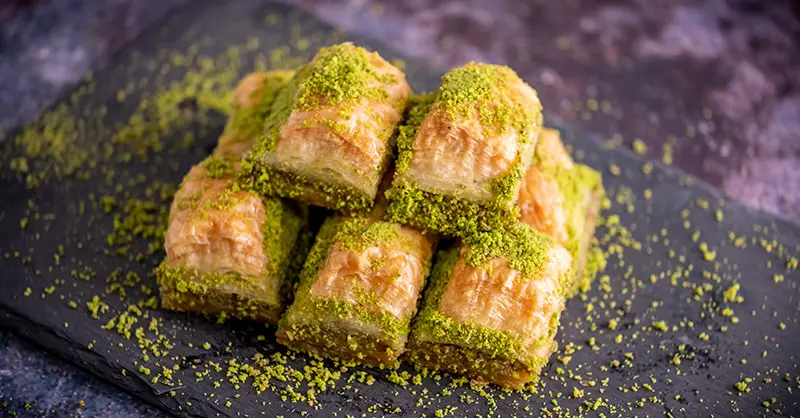
A popular treat all over the globe, baklava is a sweet, flaky pastry composed of layers of filo dough, chopped nuts, and honey or syrup.
However, with a history spanning several civilizations and centuries of development, it is just as complex and nuanced as the pastry itself.
Baklava's history provides an intriguing look into the gastronomic and cultural interactions that have influenced this delicious dessert.
Origins and Early History
There is much disagreement on the precise origins of baklava, with several nations claiming ownership of the dish. The most commonly recognized explanation dates back to the Ottoman Empire and the kitchens of Istanbul's Topkapi Palace, during the fifteenth century. But its origins may go much farther back, maybe to prehistoric Assyria, where as early as the eighth century B.C., humans are said to have baked layers of thin bread flavoured with honey and nuts.
The name "baklava" itself is of Turkish origin, but the concept of layered pastries was not unique to the Ottomans. The Greeks had their own similar pastry called "gastrin," mentioned in ancient texts, which was made with layers of dough, nuts, and honey. The Byzantines, who ruled over much of the Eastern Mediterranean before the Ottomans, also had a layered pastry called "kopton."
Evolution Under the Ottoman Empire
Baklava developed into an elegant and pricey dessert during the Ottoman era, frequently given on special occasions to the affluent. Thin, delicate layers of dough were expertly prepared by the Ottoman cooks, who then mixed them with different kinds of nuts, depending on the area—almonds, walnuts, or pistachios, for example.
The preparation of baklava in the Ottoman palace was a meticulous process, reflecting the dessert's status as a symbol of opulence and sophistication. The layers of filo dough were rolled out to be almost transparent, requiring great skill and patience. The nuts were finely chopped and mixed with spices, and the entire pastry was drenched in a sweet syrup made from honey or sugar.
Cultural Significance and Regional Variations
Baklava gained popularity along with the Ottoman Empire's growth. The dessert underwent several regional variants that are still enjoyed today as a consequence of the additions made by each area throughout the empire. In Turkey, for instance, pistachios are the favoured nut for baklava, particularly in Gaziantep's southeast, which is renowned for its premium pistachios.
In Greece, baklava is often flavoured with cinnamon and cloves, and it is typically made with walnuts. Greek baklava also tends to be sweeter than its Turkish counterpart, with a heavier use of honey syrup. In the Middle East, especially in Lebanon and Syria, baklava is often made with a combination of pistachios and cashews, and it is sometimes flavoured with rose water or orange blossom water, adding a fragrant dimension to the dessert.
Conclusion
Just as complex and delicious as the pastry itself is the history of baklava. Baklava has become a popular sweet dessert all across the world, despite its humble beginnings, refinement under the Ottoman Empire, and numerous regional variations. Enjoyed in a peaceful Greek hamlet, a busy Istanbul market, or a contemporary American kitchen, baklava never fails to thrill people who taste its sticky, nutty sweetness and to stand as a testament to culinary skill and cultural legacy.